


.png)
Hard'ack Food Forest

What is a food forest?
Food forests are perennial gardens made up of diverse plantings of trees, shrubs, and herbaceous plants, structured to mimic forest ecosystems. They are designed to be self-sustaining, resilient, and biodiverse to provide long-standing, edible plants that will feed and educate the community while supporting many additional ‘ecosystem services’. While supplying the community with a reliable food source, they also support wildlife by providing diverse habitat (food and shelter), contribute to nutrient cycling, water retention, and carbon sequestration.

Developing plans for the Hard’ack Food Forest
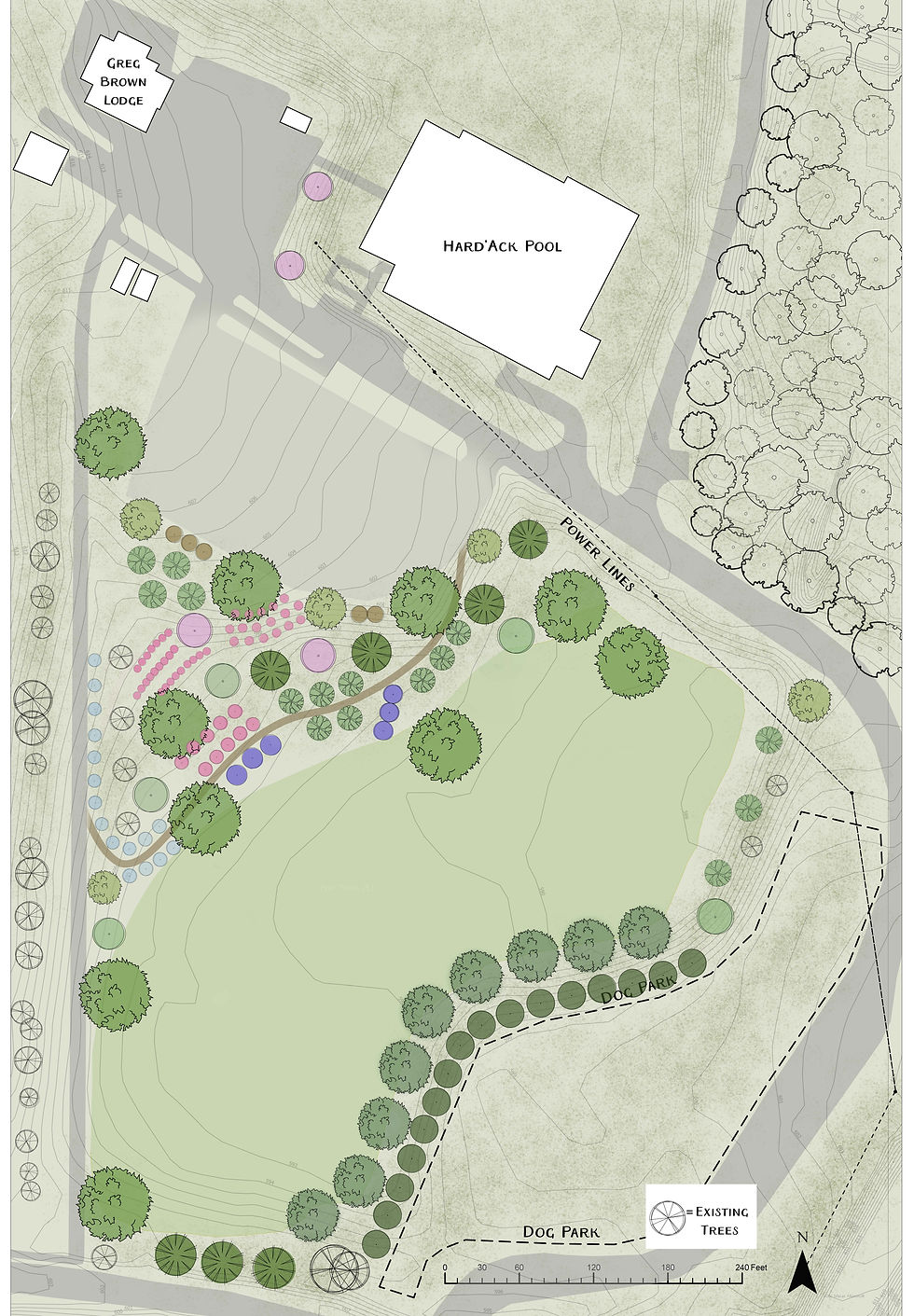
In 2024, local Saint Albans resident, Jim Stiles, presented the idea of implementing a food forest within Franklin County to the Franklin County Natural Resources Conservation District (FCNRCD) team, and the project lifted off the ground from there. FCNRCD connected with Kelly Viens, Recreation Director of the St. Albans Recreation Department, to collaborate efforts to add a food forest to the unused areas of the park. Together, Kelly and FCNRCD staff identified a swath of seldom-used land near the dog park and overflow parking. The location is just a short walk away from the Hard’ack pool and Greg Brown Lodge and situated near an existing pedestrian path extending from Congress Street.
Throughout late 2024 and early 2025, community and partner meetings were conducted to help determine the scope and direction of the food forest and how best it could serve the community. Discussion included how people wanted to be able to use the space, what food sources would be grown, and who could be involved in project design and implementation. The results from these discussions determined that the food forest will serve many purposes. These benefits include, but are not limited to, food production and security; wildlife habitat; space for educational opportunities in food production and horticulture; shaded gathering areas; and a wind break along the dog park. The food forest was designed to incorporate edible fruit- and nut-bearing trees and shrubs, medicinal species, and plants that support native wildlife. Additionally, the forest will serve to enhance aesthetics and experiences for visiting members and participants.

Species of trees and shrubs chosen for the project were also determined during these meetings. They were selected based on how well they would fulfill the project's goals (food production, education, wildlife habitat, aesthetics, windbreak, and shade). Site conditions were also a determining factor in species selection. These factors include hardiness zone, drainage, wind speeds, soil conditions, aspect and sun exposure, proximity to infrastructure and roads, potential nutrient runoff from the dog park, and pedestrian flow patterns. Many species chosen are Vermont natives; however, naturalized species and non-natives species, such as Korean Nut Pine and apple trees, were chosen due to their food production and educational benefits. All selected species were prioritized to be disease and pest resilient, except for American Chestnut which will be grown alongside hybrid chestnut varieties to encourage resistance against chestnut blight. The planting palette list can be found below.

Eastern Redbud Chokeberry White Oak Apple Plum Serviceberry
Collaborators
This project has been a truly collaborative effort, from ideation through implementation. Planning meetings from 2024 into early 2025 involved over 45 community members, who shared resources and knowledge, and provided thoughts on species selection, design considerations, potential partnerships, and how to support long-term success of the food forest. St. Albans Recreation Department staff reviewed and informed designs, assisted in preparing the planting space, and assisted with ongoing care of the planting, including mowing and coordinating watering through the 2025 drought. Many hands were involved with getting plants in the ground, including volunteers from the UVM Extension Master Gardener Program, students and instructors from the Outdoor Technologies Class at Northwest Career & Tech Center, Franklin County NRCD staff, and volunteers from the broader community.
The ability for this project to grow from idea to reality within the span of a year was made possible by the support of the Vermont Urban and Community Forestry Program, which supported the purchase of the majority of the stems planted at the food forest, through the Community Tree Planting Grant. VTUFP staff, including forester Adam McCullough, also provided technical guidance throughout the planning and implementation of the project. We would also be remiss if we did not mention and express gratitude to the nurseries that provided trees for this project and worked with FCNRCD to coordinate species selection and delivery. These nurseries include East Hill Tree Farm in Plainfield, which provided many of the fruit and nut producing trees, Boro Hill Nursery in Monkton, Horsford Garden and Nursery in Charlotte, and B&B Nursery in Morristown.
The Hard’ack Food Forest will also support many future collaborations. In 2025, the site was approved as an ongoing UVM Extension Master Gardener project site. As a Master Gardener project site, it will serve as a space for hosting future horticultural workshops such as fruit tree pruning, grafting, pest management, and harvest workshops. Master Gardeners will have the opportunity to gain volunteer hours by stewarding the site. The food forest will also support educational and youth programming coordinated by the Recreation Department, which hosts many summer camps and after school programs throughout the year. The Franklin County NRCD will also continue to be involved with the site in the years to come, though stewarding the trees to ensure successful establishment, and also through continued educational programming and partnerships.
Project Implementation as of March 2026
FCNRCD, partners, and volunteers have completed several planting days to build the food forest over the past year and have more planting days coming! (More information on upcoming planting days will be discussed below.)
Starting in Spring 2025, the Outdoor Technologies Class at Northwest Career and Tech Center carried out the first planting of tree stems and fruiting shrubs using design maps developed by Dorothy, one of FCNRCD’s Natural Resources Planner and a Master Gardener, alongside collaborators. The plants were funded and provided by FCNRCD’s own tree sale

In early June 2025, more trees were planted by volunteers and NRCD staff. This included many of the trees purchased with funding from the Vermont Urban & Community Forestry Program Community Tree Planting Grant. Volunteers included Master Gardeners from the UVM Extension Master Gardener Program, local students, and community partners involved with earlier planning efforts.
A total of 26 volunteers, including students, teachers, Master Gardeners, and locals, have helped install 95 trees and shrubs as of summer 2025. With more plantings coming, we hope to have more people involved as we develop the food forest.
FCNRCD staff getting volunteers ready for tree planting!
Ongoing Efforts
The next steps are to plant a wind break of Balsam firs and Eastern white cedars along the dog park through more planting days coming in spring 2026. Ongoing maintenance such as replanting trees and shrubs that did not survive and controlling the competing understory plants (until the forest is well established) are in the works for this spring and summer.

The Hard’ack Food Forest is a new and ongoing project that will take several years to come to full fruition as the trees and shrubs grow. Though food production may be modest in the first few years, there are many opportunities to learn and observe the food forest as it grows. We hope that you, your family, and other visitors enjoy watching this forest grow and benefit from the many services it provides! The FCNRCD team is thankful for all the partners and volunteers that have contributed to the planning and implementation of this project thus far and is looking forward to the next steps in making the food forest grow!
If you are interested in becoming involved or have questions, email us at info@franklincountynrcd.org, We cannot wait to connect with you and continue building the Hard’ack Food Forest!
Upcoming Events:
May 12 , 2026: Volunteer Tree Planting Day at Hard'ack Food Forest. We plan on planting the windbreak trees and additional trees in the food forest, along with some light maintenance like mulching from 10am to 3pm (264 Hard'ack, St., Albans, VT).
If you are interested in participating, please reach out to Sadie Preece at sadie@franklincountynrcd.org


Comments