


.png)
Innovative Riparian Buffers: Exploring a Direct Seeding Approach
- FCNRCD

- 17 hours ago
- 3 min read
On Wednesday, August 19th, 2026, 37 participants joined staff from the Intervale Conservation Nursery and Riparian Lands Native Seed Partnership, as well as the Franklin County NRCD, US Fish & Wildlife Service Partners for Fish & Wildlife Program, Vermont Agency of Agriculture (CREP Program), and the Vermont Fish & Wildlife Department to learn about and discuss innovative approaches to riparian buffers.
This event was the third in a series of Innovative Riparian Buffer Workshops held in 2025 and 2026 by the Franklin County NRCD. The workshops are designed to discuss and explore a variety of innovative sites, planting styles, and outcomes associated with planting plans, site preparation, and implementation.
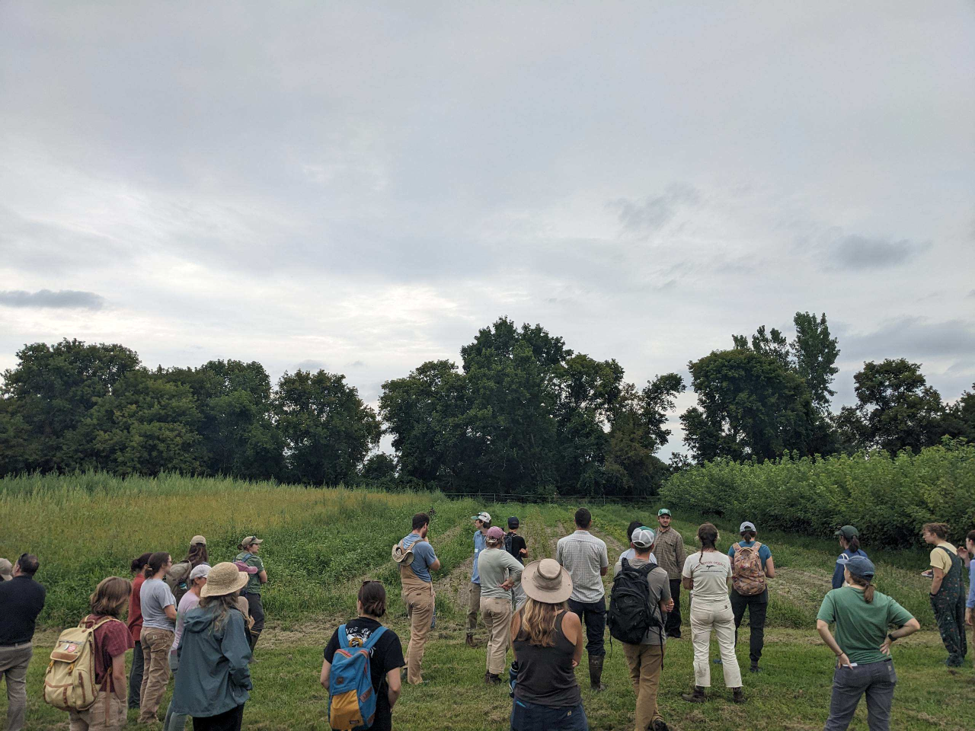
During this event, participants explored a 2025 direct seeding site on the Fitzgerald Farm / Intervale Wildlife Management Area in Colchester. The site is located on a peninsula of land surrounded by the Winooski River.
The seed used at the site was collected by crews from the Intervale Center and NorthWoods Stewardship Center. Seed was sourced from diverse local sites throughout Vermont, including state lands such as Wildlife Management Areas and Access Areas, as well as state parks, town-owned properties, The Nature Conservancy properties, university properties, and other private lands.
The site had been planted with corn and treated with herbicide the year prior to seeding, so no additional site preparation was required.

This site provided an opportunity to evaluate the most effective seeding densities for tree establishment. Three different seeding rates were tested across a series of 24 100-by-100-foot plots: 10 seeds per square foot, 50 seeds per square foot, and 100 seeds per square foot, along with a control plot. The plots were established and seeded between May and July 2025 by the Vermont Fish & Wildlife Department, Intervale Center, and NorthWoods Stewardship Center.
Two plots were seeded using a hydro seeder. However, after complications with the motor, the remaining 22 plots were seeded by hand, with seed broadcast as evenly as possible across each plot.
A water wheel provided by the Vermont Fish & Wildlife Department was brought to the site and used to water the seeds. All plots were watered with the water wheel immediately before and after seeding. Many of the species broadcast at the site germinate readily under moist conditions and are sensitive to drying. Five additional rounds of watering occurred during the three weeks following seeding, along with a period of rainstorms that provided additional moisture.

In August 2026, approximately one year after seeding, one could see oak, maple, dogwood, and other tree seedlings beginning to establish. The site also had dense vegetation, including goldenrod and lambs quarters.
Several oak seedlings were observed, which was particularly encouraging because oak trees are not present in the surrounding forest. Their presence indicates that they likely originated from the seed applied during the seeding trial and were not volunteers from nearby trees.
In the afternoon, the group toured the Intervale Conservation Nursery. Ben Rodgers led participants through the nursery’s tree-growing process, from starting seeds in the greenhouse to planting seedlings in the field and processing them for distribution. Brooke Fleischman also provided an overview of the seed-collection process, including the tools and equipment used to collect and process seed.

The Franklin County NRCD enjoyed connecting with everyone to discuss riparian planting, share successes and lessons learned from previous projects, and explore ideas for the future. Thank you to everyone who attended the workshop!


Comments